When AI Works but Humans Consume: The Real Structure of the Future Economy

Every technological age is defined by the limits of its machines. Steam engines could push, pull, and rotate. Electricity could illuminate, drive motors, and connect continents. Computers could calculate and store. But all of these machines shared one trait: they were tools. They extended human capability, but they did not replace the human role at the center of economic life.
Artificial intelligence alters that balance. Not because it thinks, and certainly not because it threatens to abolish human purpose, but because it can perform what used to be considered intellectual labour. AI writes, sorts, classifies, designs, optimizes, predicts. It is the first form of machinery that can do the work of the mind.
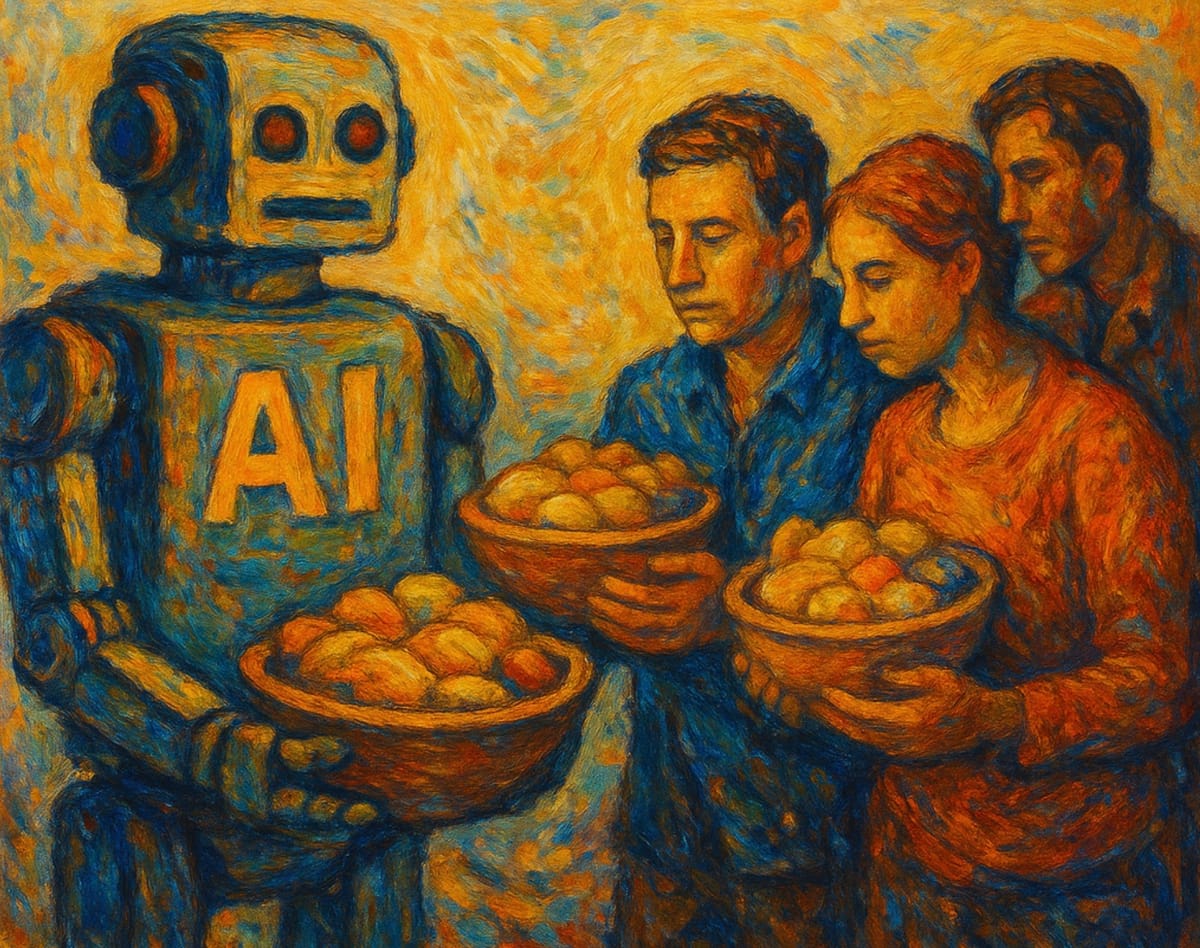
But even this description misses the real significance of AI. The essential fact is simpler and far more profound. Machines can work but cannot consume.
They produce, but they cannot enjoy. They generate output, but they cannot desire its outcome. They create value, but they cannot use it. That single asymmetry defines the future of the human economy. Once you grasp this point, the panic surrounding AI becomes almost absurd.
The Great Misunderstanding: AI Does Not Replace the Consumer
Most fears about AI are built on a confused premise, that machines replacing human labour somehow ends the economic role of humans. This assumes that the economy exists because people work. In truth, the economy exists because people want things. Production responds to desire, it does not create it. Our wants: material, emotional, symbolic, are the source of all economic motion.
AI can produce endlessly, tirelessly, and cheaply. But it cannot want. It cannot need. It cannot choose. It cannot prefer one good over another. It cannot feel satisfaction or dissatisfaction. It cannot be persuaded, inspired, alienated, uplifted, or exhausted.
AI reduces the scarcity of labour, but it does not reduce the scarcity of meaning. And meaning is the real currency of economic life.
In this sense, AI does not eliminate the human position. It elevates it.
When Production Becomes Abundant, Human Judgment Becomes Precious
Imagine a world where AI handles most productive tasks: drafting, assembling, computing, routing, predicting, building, refining. Tasks that once required teams become effortless. What becomes scarce in such a world?
Not labour. Not output. Not efficiency. What becomes scarce is direction.
Someone must still decide what should be produced. Someone must interpret the needs, desires, fears, and aspirations of human beings. Someone must determine which of the infinite possible forms of production corresponds to what humans actually value.
This is where the new competition begins. Humans will not compete with AI; they will compete over the surplus generated by AI.
The winners are those who understand human wants more clearly than their peers and who can translate those wants into instructions that machines can execute. The economy becomes a contest of allocation, interpretation, and foresight, not of physical endurance or routine mental effort.
The Collapse of the Old Wage Logic
For centuries, human income was tied to the scarcity of human labour. In the AI age, this connection breaks. Labour loses its pricing power. What matters is your position in the chain of allocation.
A person who can direct AI effectively may command the productive capacity of what used to be an entire department. The economic hierarchy reorganizes itself around leverage, not effort. Some individuals become a hundred times more capable, not because they work harder, but because they know what to do with infinitely cheap machine labour.
This is not catastrophic. It is clarifying. It exposes what was always true but deeply hidden, income follows influence, not exertion.
Machines Cannot Spend Money — Only Humans Can
In a world of automated production, the role of the human shifts decisively toward the consumption and distribution side of the economy. It is not a trivial role. Consumption is not merely buying products, it represents the structure of human preference, aspiration, and culture. It determines which futures are possible.
As long as the human being remains the only creature capable of desire, the economy remains a human institution.
This means the true conflict of the coming age is not between humans and machines, but between humans who know how to position themselves within machine-driven abundance and those who do not.
The Danger Ahead: Political Reaction, Not Technological Displacement
The only way the promise of AI can be squandered is through misguided political intervention, freezing labour markets, restricting use, taxing machine output into oblivion, or attempting to preserve obsolete structures for the sake of appearances. When governments try to protect the past, they prevent society from accessing the benefits of the future.
The tragedy is that AI could massively expand human prosperity, if left alone. Production would become cheaper, goods more abundant, and human creativity freer. But if policymakers treat AI not as an opportunity but as a threat, the natural surplus it generates will be strangled long before it reaches the public.
Machines cannot steal prosperity. Only human decisions can.
A Human Economy After All
In the end, AI brings us back to a simple truth about economic life. Labour is not the foundation of the economy. Desire is. The human capacity to want, to imagine, to prefer, to judge, to find meaning, this is what makes an economy possible.
Machines may perform the tasks, but humans provide the goals. Machines can craft the product, but humans decide what is worth crafting. Machines can generate unlimited output, but humans determine its value.
The economy of the future will not be a post-human wasteland. It will be a deeply human landscape organized around a new question: Who can best turn machine labour into human flourishing?
This is the real frontier — and the real opportunity.